Benchmarking Ollama vs vLLM
Tuesday 24 November 2026 Thibault Debatty 57 views
One often states that vLLM is faster and better suited for production than Ollama but… by how much?
In this blog post we benchmark both frameworks to get the real numbers. Unlike many other benchmarks, we also study the behavior of both frameworks when multiple users use the provider concurrently.
TL;DR In this benchmark, vLLM significantly outperforms Ollama in high-concurrency scenarios. While Ollama is excellent for single-user local tasks, vLLM’s optimizations allow it to maintain low TTFT and high throughput even as user load increases. For the Gemma 4 model, vLLM’s TTFT was nearly 200x faster under load.
Experimental setup
To run the tests I used a workstation equipped with a NVIDIA RTX 5090 (32GB vRAM).
The tests were executed with Python tokenhammer. This script simulates multiple users hammering the LLM provider in parallel.
https://gitlab.cylab.be/cylab/tokenhammer
I tested with 2 common open-weight model : Gemma4:26b and Qwen3.8:27b.
Gemma 4 26B is an open-weights large language model developed by Google DeepMind. It is designed to offer a powerful balance between computational efficiency and advanced reasoning capabilities while running on commodity hardware.
Qwen 3.8 27B is also an open-weights model from Alibaba, released in August 2026, designed for coding, agentic tasks, and long-horizon workflows. The model is notable for its efficiency, fitting into ~17GB of VRAM/RAM with 4-bit quantization, making it runnable on consumer hardware while delivering frontier-level performance, outperforming larger models in coding benchmarks.
Results
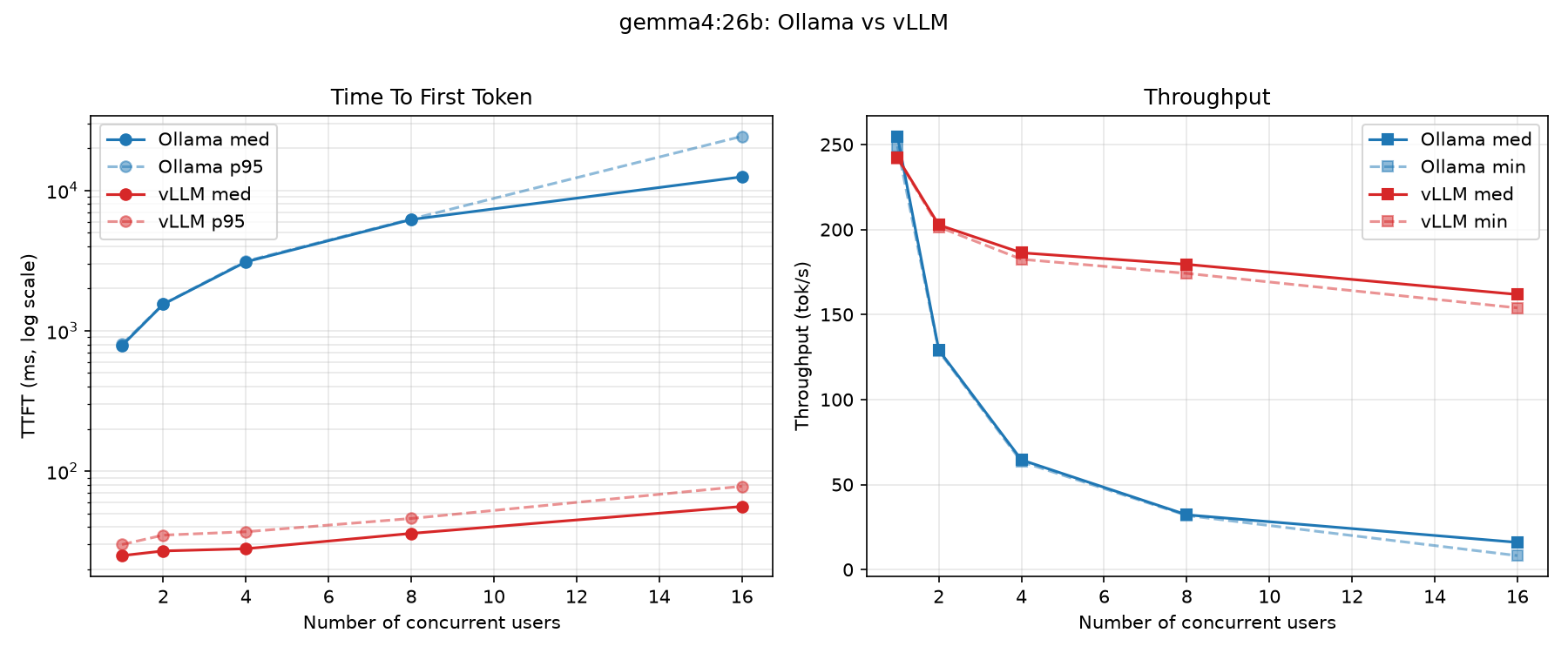
With Gemma4, vLLM largely outperforms Ollama, especially when two or more users are using the model concurrently. Regarding TTFT, the difference is so large (56ms vs 12s for 16 concurrent users) that I had to use a logarithmic scale to represent both on the same graph.
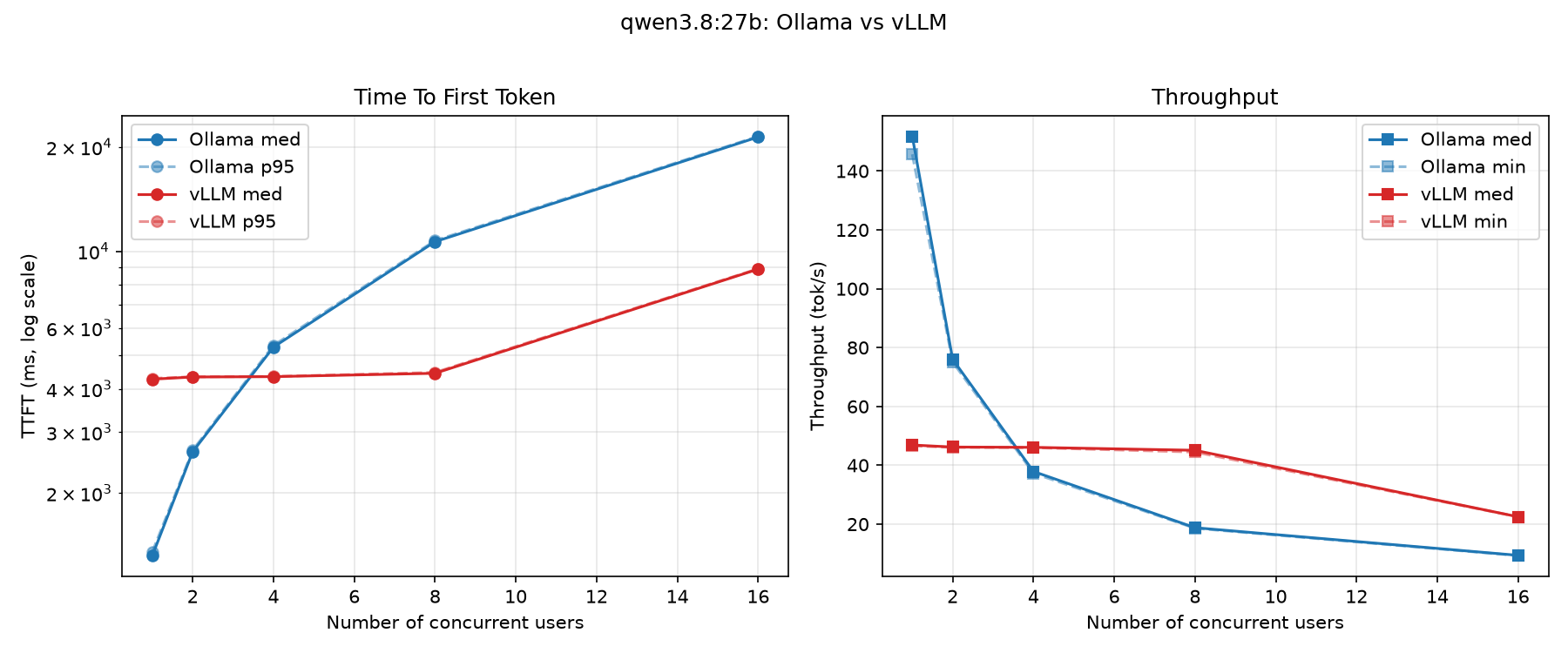
Qwen 3.8 is a more demanding model and the results are more contrasted. With only 1 or 2 users, Ollama manages to outperform vLLM, but when the number of users increase, vLLM handles parallelism much better and takes the advantage, delivering 45tok/s with 8 concurrent users.
Detailed results
If interested, here are the detailed results for each test.
Gemma4 26b
Ollama produced the following results when running Gemma4:26b
==============================================================================
SUMMARY
 users   req  fail    TTFT med   TTFT p95   tok/s med  tok/s min
----------------------------------------------------------------
     1    10     0       785ms      802ms       254.8      248.9
     2    20     0      1549ms     1551ms       129.1      128.4
     4    40     0      3103ms     3142ms        64.5       63.4
     8    80     0      6214ms     6263ms        32.2       31.8
    16   160     0     12518ms    24336ms        16.0        8.2
==============================================================================
vLLM was executed using Docker, with the following command:
sudo docker run --gpus all \
  -v ~/.cache/huggingface:/root/.cache/huggingface -p 8000:8000 \
  --ipc=host vllm/vllm:v0.34.0 -\
  -model cyankiwi/gemma-4-26B-A4B-it-AWQ-4bit \
  --max-model-len 96000 \
  --kv-cache-dtype fp8 \
  --gpu-memory-utilization 0.95
- https://github.com/vllm-project/recipes/blob/main/Google/Gemma4.md#quantized-models-qat-w4a16
- https://recipes.vllm.ai/Google/gemma-4-26B-A4B-it?hardware=rtx_5090
And produced the following results.
==============================================================================
SUMMARY
 users   req  fail    TTFT med   TTFT p95   tok/s med  tok/s min
----------------------------------------------------------------
     1    10     0        25ms       30ms       242.3      242.0
     2    20     0        27ms       35ms       202.7      201.5
     4    40     0        28ms       37ms       186.3      182.5
     8    80     0        36ms       46ms       179.5      174.2
    16   160     0        56ms       78ms       161.8      153.9
==============================================================================
Qwen3.8:27b
On Ollama, Qwen3.8 produced the following results:
==============================================================================
SUMMARY
 users   req  fail    TTFT med   TTFT p95   tok/s med  tok/s min
----------------------------------------------------------------
     1    10     0      1318ms     1351ms       151.8      145.7
     2    20     0      2633ms     2660ms        76.0       75.1
     4    40     0      5283ms     5344ms        37.9       37.3
     8    80     0     10653ms    10734ms        18.8       18.6
    16   160     0     21385ms    21484ms         9.4        9.3
==============================================================================
vLLM was also executed using Docker, with the following command:
sudo docker run --gpus all \
  -v ~/.cache/huggingface:/root/.cache/huggingface  \
  -p 8000:8000 --ipc=host vllm/vllm:v0.34.0 \
  --model Inferact/Qwen3.8-27B-NVFP4 \
  --max-model-len 32768 \
  --kv-cache-dtype fp8 \
  --enforce-eager \
  --tensor-parallel-size 1 \
  --enable-auto-tool-choice \
  --tool-call-parser qwen3_coder \
  --reasoning-parser qwen3 \
  --mm-encoder-tp-mode data
And produced the following results:
==============================================================================
SUMMARY
 users   req  fail    TTFT med   TTFT p95   tok/s med  tok/s min
----------------------------------------------------------------
     1    10     0      4266ms     4287ms        46.9       46.6
     2    20     0      4329ms     4336ms        46.2       46.1
     4    40     0      4339ms     4344ms        46.1       46.0
     8    80     0      4437ms     4462ms        45.1       44.5
    16   160     0      8874ms     8900ms        22.5       22.5
==============================================================================
Conclusion
At the end of this short benchmark, the most striking result was the TTFT when running Gemma4:26b. While Ollama’s TTFT increased linearly with the number of users (reaching 12s+), vLLM kept it under 60ms. This confirms that vLLM is significantly better suited for real-time multi-user chat applications. But Ollama also has use cases:
- use Ollama if you want to easily switch between different models, and you only have a single user.
- use vLLM if multiple users will hit the endpoint simultaneously.
This blog post is licensed under
CC BY-SA 4.0


